
Newsletter, 7/10/26
ALL 4IR

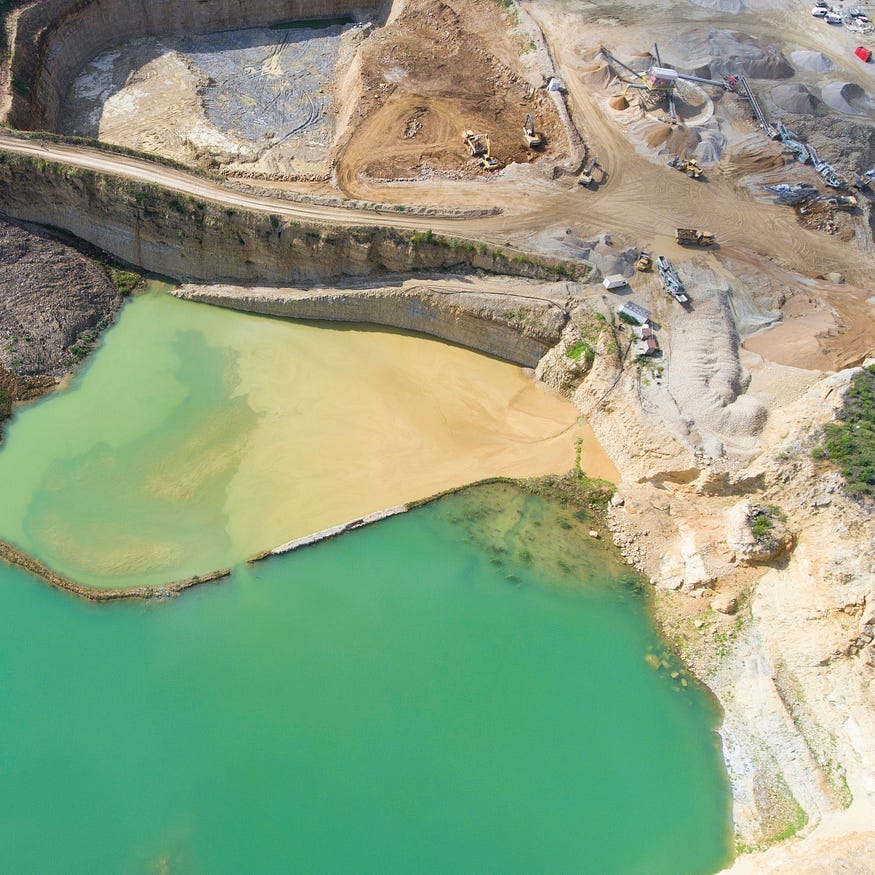
{Tailing, one of the huge costs which come with “renewable energy.” Image by Curioso Photograohs on unsplash dot com, via thehonestsorcerer do substack dot com}
The latest from Jeff Snider. Inside the pretty bad sales report from consumer giant PepsiCo., the reported amount of product sold (not revenue, but physical amount, as in cans, bottles,…) dropped sharply last month. Overall credit numbers and home sales numbers are quite bad too. He clarifies how what the data show is not inflation but demand destruction, with further ramifications on down the line.
Pepsi Gives MASSIVE Warning Of Consumer Behavior. Jeff Snider/Eurodollar University, 7/9/26, 20 minutes.
“PepsiCo just reported earnings. And buried inside a perfectly standard corporate press release was one of the most important sentences you’ll hear about the American economy this year. CEO Ramon Laguarta said, and I’m quoting directly here: “I think the consumer is worse than what we had anticipated, and it’s driven mainly by gas prices.” {Bolding by Jeff Snider}
That’s not a fringe analyst. That’s the chief executive of one of the largest consumer goods companies on the planet, a company that sells beverages and snacks to hundreds of millions of Americans every single quarter, telling you directly: something has changed. For one thing, credit card use dropped sharply, as we’ll see.”
The latest from the Southwest Asia WW3 War Theater. War is Peace, and now we have war and peace together, or at least war and peace talks. Or so we’re told. First up, YNET, Israel’s largest media outlet, which is connected with the IDF. The account is by Reuters.
Iran tells US ‘errant’ forces attacked ships in Strait of Hormuz, official says. Washington says Tehran must publicly halt attacks, guarantee toll-free passage through all Strait of Hormuz shipping lanes and hand over its highly enriched uranium, as new sanctions target a financier tied to Mojtaba Khamenei. Reuters, 7/10/26,
The United States is demanding that Iran publicly commit to ending attacks on ships in the Strait of Hormuz, guarantee that all shipping lanes remain open and abandon any effort to charge vessels for passage, senior U.S. officials said Friday.The demand comes as Washington imposed a new round of sanctions targeting a financier allegedly linked to Iran’s new leader, Mojtaba Khamenei, and a network of exchange houses and front companies accused of moving billions of dollars for sanctioned Iranian banks and the country’s ruling elite.
Iran has refused to relinquish control over the Strait of Hormuz, the strategic waterway through which roughly one-fifth of the world’s oil supply normally passes. U.S. officials nevertheless said recent contacts between Washington and Tehran had been productive. “What we’re demanding is that the Iranians issue a public statement that acknowledges all channels of the Strait of Hormuz are open and they’re not shooting at ships anymore,” one senior official told a small group of reporters during a conference call.
“They’re either going to give us that statement or we’re not having a good outcome for them,” the official said.
According to another senior official, Iran told Washington that the recent attacks on commercial shipping were carried out by “an errant part of their system.” U.S. officials said the explanation appeared to reflect a power struggle unfolding between Iranian hardliners and more pragmatic elements of the leadership. Three Qatari and Saudi commercial tankers came under fire during the past week, prompting the United States to strike Iranian sites. Tehran then responded by attacking U.S. military installations in Gulf states.
President Donald Trump declared that a ceasefire signed by the two countries in June was over, although Washington agreed to continue negotiations at Iran’s request. “We are hoping to get to a place where they publicly say that they will stop shooting at ships and sort of explicitly, or at least implicitly, acknowledge that they screwed up,” one official said. “The president has directed us to talk, but as he’s shown a willingness to do, if they keep on shooting at ships or they engage in any other hostile acts, then we’re going to hit them back,” the official added. Iranian Foreign Minister Abbas Araqchi is expected to travel to Oman on Saturday for talks on bilateral relations and regional developments, particularly the situation in the Strait of Hormuz, Iran’s official IRNA news agency reported.
Beyond the shipping dispute, U.S. officials said Washington’s fundamental demand remained the transfer of Iran’s nuclear material. Tehran is believed to possess more than 900 pounds of highly enriched uranium, which Trump and other U.S. officials have referred to as “nuclear dust.”The nuclear issue is supposed to be addressed during a 60-day negotiation period established under a memorandum of understanding signed by the two countries in June.“I just want to be clear here that if we don’t get the dust, we do not have a deal with Iran,” one official said. The official said Washington had “a lot of options” if Iran refused, including both military and economic measures. Iran has said it is prepared for “all-out defense” if the United States violates the memorandum. Its chief negotiator, Mohammad Baqer Qalibaf, wrote on Telegram that the conflict would never end with Tehran’s surrender.
The U.S. Treasury Department on Friday announced sanctions against Iranian banker and businessman Ali Ansari, who is based in Dubai, as well as 13 other individuals and entities. Britain had previously sanctioned Ansari over accusations that he financially supported Iran’s Revolutionary Guard Corps and other Iranian organizations. The Treasury said Ansari diverted publicly funded wealth into an extensive overseas portfolio of real estate and commercial assets, enriching himself, Iranian government elites and the IRGC. “Although held in Ansari’s name, many of these financial interests are ultimately held for the financial benefit of Mojtaba Khamenei, his family and other Iranian elites in the regime and the IRGC,” the Treasury said.
The department accused those figures of protecting Ansari from punishment despite what it described as his corruption and the economic damage he caused Iran and its population.
Ansari previously owned and directed Ayandeh Bank, which was sanctioned by the United States and later declared bankrupt. Iranian authorities ordered the bank closed in mid-October 2025. According to the Treasury, Ansari used shell companies and bank accounts across several jurisdictions to accumulate holdings worth millions of dollars under Smart Global Limited, a Saint Kitts and Nevis-based holding company established in 2011.
The company invested in real estate and commercial properties in Europe, the Gulf and other regions, the Treasury said. The Treasury’s Office of Foreign Assets Control also sanctioned three Iran-based currency exchange houses and foreign companies accused of transferring billions of dollars each year on behalf of blacklisted Iranian banks. Officials said the network used layers of shell companies to conceal financial activity on behalf of the Iranian government. “The United States is taking decisive action to cut off the financial lifelines sustaining Iran’s ruling elite,” State Department spokesman Tommy Pigott said. “By targeting these networks, the United States is directly disrupting the regime’s ability to access foreign currency and conduct international financial activity.”
The sanctions also targeted Iranian nationals associated with the exchange houses, Hong Kong-based CDM Trading Limited and Naba Alzaki Raw Materials Trading LLC in the United Arab Emirates. Treasury Secretary Scott Bessent said the department would “continue using every tool at its disposal” to isolate Khamenei and other senior Iranian officials from the international financial system. The sanctions could further complicate negotiations because Article 9 of the June U.S.-Iran memorandum states that Washington will not impose new sanctions or deploy additional forces in the region.
Brett Erickson, managing principal at Obsidian Risk Advisors, said the measures indicated that Washington was preparing for the possibility that the existing diplomatic framework would collapse. “Washington is no longer trying to salvage the existing framework,” he said. “It’s preparing to replace it entirely.”
More on reports of internal unrest in Iran from the Israel outlet which is owned by the US-based Adelson corporate group.
Pezeshkian at risk of ouster as Israel, US explore ways to topple Iran’s regime. Western diplomatic officials warn of a “loss of restraint” and attempts to harm the president and Foreign Minister Abbas Araghchi, who admitted to the Americans: “We have no control over the shoal in the Gulf.” As the crisis worsens, Israel and the US are examining steps to bring down the Iranian regime. Danny Zaken, 7/9/26.
Diplomatic officials from the region and the West have voiced concern for the fate of Iran’s political and civilian leadership, which advanced the memorandum of understanding with the US.
According to these officials, the attempts to harm Foreign Minister Abbas Araghchi and President Masoud Pezeshkian during the mourning events and funeral procession for Ali Khamenei point to a loss of restraint toward them by the heads of the Islamic Revolutionary Guard Corps. One official, who is well versed in developments inside Iran, told Israel Hayom that as part of the internal dispute in Iran, which has intensified following the signing of the memorandum of understanding, Guard commanders could take control of the civilian leadership and move to oust Pezeshkian’s government.
Israel Hayom reported that Araghchi made clear in his latest messages to his American interlocutors and to mediators from Pakistan and Qatar that Iran’s political leadership was unable to secure the Guards’ consent to the terms of the agreement or to the cessation of fire at tankers and ships passing through the Gulf.
The remarks were made, among other occasions, in a conversation with Qatari Prime Minister Sheikh Mohammed bin Abdulrahman al-Thani, who demanded explanations as to why Guard personnel had fired at a Qatari tanker carrying liquefied natural gas as it tried to pass through the Strait of Hormuz. The diplomatic officials said Guard personnel were leveling accusations against the political leadership that bordered on treason, claiming they had exceeded the mandate given to them in the negotiations by giving up on the issue of fees in Hormuz and on uranium enrichment on Iranian soil. Claims are also being made that the political leadership concealed some of the understandings with the US from other senior regime officials, foremost among them the Guard commanders.
Given this situation, the US administration, as well as Israel and countries in the region, are examining the options for how to act, and whether there is a chance to bring down the regime and help create the conditions for doing so, even if this is a long process. One of the clear conclusions is that in order to advance such a goal, the economic siege on Iran must be restored quickly. For now, Iran has managed to bring in billions of dollars from renewed oil exports, which resumed with the thaw with the US two and a half weeks ago.
Data from ship-tracking organizations show that the passage of tankers and ships along the southern route near Oman has stopped completely. Iranian tankers, too, are barely passing through, apart from three oil tankers that headed for the Far East. They join an especially large convoy of Iranian tankers that left the Gulf at an accelerated pace in recent days, in an effort to take advantage of the time left for exports. The US did cancel the decision to suspend sanctions on oil exports, but allowed Iran to complete deals that had already been arranged by the middle of next week. In doing so, Iran has once again, at least temporarily, managed to close the strait while continuing to export oil itself.
Meanwhile, the internal dispute among Gulf states is widening. The United Arab Emirates, along with Bahrain and Kuwait, is demanding far-reaching decisions against Iran through a joint move by the Gulf Cooperation Council. Among other things, they are demanding the advancement of an international decision, including at the UN Security Council, guaranteeing free and open passage for all in Hormuz, in order to neutralize Iran’s demand to preserve its control there. They are also demanding an international military initiative to defend this critical waterway, a move that would lead to the resumption of tanker and ship traffic in the near term.
Qatar, which is mediating and is close to Iran, holds the position that despite the shooting, diplomatic efforts must continue, since the military steps against Iran have failed and even led to the Iranian response in Hormuz. Oman supports Qatar’s position, while Saudi Arabia remains on the fence but completely rejects naval military action and a return to war against Iran. What all these countries have in common is disappointment with the US, which, at least for now, has not managed to bring about the opening of the strait or remove the Iranian threat against them through either diplomatic or military means.
This video talks about the entire crisis we face, of which only one facet, “climate change” (runaway climate chaos caused by the operations of the global capitalist industrial system) is talked about a lot, while the other planetary boundaries that humanity is currently transgressing — biodiversity loss, nitrogen and phosphorus loading, land-system change, freshwater use, and the release of novel entities into the biosphere to name a few, get little mention.
Reality of Everything Symposium - The Polycrisis. The Reality of Everything, 7/8/26, 12 minutes.
“The Reality of Everything Symposium was a bold forum to confront the interconnected crises shaping our lives and futures, building the foundations for informed, collective action. Dr Mike Joy’s talk exploring the polycrisis is one of the eight expert talks from the Symposium. Find transcripts, key points and other resources at {URL, realityofeverything dot org }
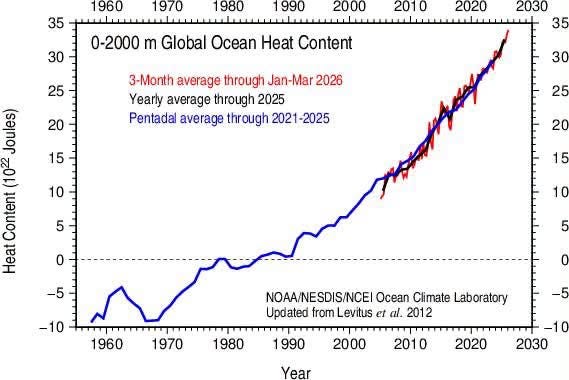
Here is one consequence of the mounting runaway climate chaos, runaway rise in the heat content of the oceans.
Ending this segment and this edition. the ecological devastation and high demand for resources and energy wrought by “renewable energy.” Very educational photographs.

…and when we do, shit’s going to get real. B, The Honest Sorcerer, 7/10/26.
There are no “renewables” without mining, an unsustainable practice turbocharged by the burning of fossil fuels. Yet, advocates of green technologies still believe that we could “somehow” electrify the recovery of critical minerals, and continue with civilization in a “business as usual but greener” manner. In reality, this could not be further from the truth.
Before we delve into the topic of why using renewables to continue with extracting metals from Earth’s crust is a self-defeating proposition, let’s tackle the environmental aspects, and the deep connections of this activity to fossil fuel use, first. Perhaps it’s no exaggeration to say that the term “building a mine” is actually an euphemism for environmental destruction on a truly industrial scale. First of all, opening a site for mineral extraction inevitably comes with destroying the green blanket of a living habitat. It also takes large harvesting machines to cut down all those trees and shrubs—all powered by diesel fuel, of course, as there are no power plugs nearby to do all this with electric chainsaws. Then a bunch of diesel guzzling bulldozers are brought on site to build roads leading to the would be mining site, followed by a fleet of trucks to haul all those logs away—again, by burning diesel—as the distance and load is usually far-far beyond what an electric semi could cover.
Once the site is cleared of all life and all the topsoil was removed (or destroyed in the process), explosives are used to blast away rocks covering those precious ores we are about to go after. Building a mine often comes with removing and crushing thousands of feet of hard stone, which is then get spread on the newly built dirt roads to make them sturdier. In some cases a mile or more of rocks will have to be removed, before any mineral extraction could be started in earnest. This process usually takes years, or a decade even, till the actual mining equipment can be brought on site at last, together with power lines to bring the stationary machines to life. If there are no power lines nearby, an electric generation facility has to be built (burning fossil fuels of course, due to the 24/7 power demand of a mine).
Finally, when the mine starts operating, diesel powered excavators and dump trucks begin to do the shoveling, working in concert with explosive engineers exposing layer after layer of the ore they are going after.1 Ores brought up by diesel trucks then need to be crushed into a fine powder using electric grinding machines and mixed with lots of water laced with aggressive chemicals (like sulfuric acid, a byproduct of refining oil) to leach out their metal content. Once scrubbed for metal salts (the end product of mineral extraction), this process leaves behind a huge toxic tailing—another ticking time bomb waiting to explode. All this to exploit a finite resource then to move on to the next prospect.
No wonder people around the world oppose even the idea of a mine being opened in their neighborhood: living downstream to any such operation is a disadvantageous proposition, to say the least. Rivers, lakes and groundwater often get contaminated with heavy metals and poisonous chemicals, making the water unsafe for watering grass even. Mining also leads to sinkholes, erosion, increased noise and dust levels, biodiversity loss and habitat fragmentation. Mines also compete for water with local communities, and tend to increase worker exploitation in the area. ‘Not in my backyard!’ is thus not just a fancy slogan for local communities, but a matter of existential nature.
If all this haven’t spoiled your appetite for more mineral extraction, you might ask: why don’t we power this activity with “renewable” electricity then? OK, but which part? Excavators? Probably in a coal mine going after a seam of pure lignite, with power directly fed back from a nearby power plant. But metals needed for renewables are often embedded in hard rock, requiring a caterpillar driving around and hauling massive rocks on a dumper. Trucks, then? Sure, in a coal mine with a power plant nearby or, perhaps, in a clay or limestone mine located near the surface, up on a hillside. You see electric dumper trucks are best utilized if they are loaded on the top of a hill, then driven down to the valley where these materials are used in making cement or get burned for power. The weight difference between the light ascent and heavy descent is enough to charge the batteries, and make the climb back to the mine a freebee. In an open pit, however, you have to drive down to a man-made canyon empty and climb back loaded with heavy ores — exactly the opposite what is needed to charge the batteries on the way. Besides, you are likely hundreds of miles away from the nearest power plant… This means that you would need to install huge solar panel and wind turbine arrays near the pit where the trucks would spend at least half of their useful time charging. Swapping batteries might be an option here, but since the battery itself is a huge cost factor, buying 2, 3, or perhaps 4 of them per vehicle increases investment cost considerably—turning an already thin margin deeply negative.
Apart from the obvious question of ‘just how economic is that?!’, this leads us to a much more ominous phenomenon: resource cannibalism. As long as we mine using diesel machines mostly built from abundant steel, and burning fossil fuels, there is little to no copper, lithium, cobalt etc. needed to be invested into the extraction of the metals much needed for the “transition”. However, if we were to switch to mining goods with electric trucks powered by “renewables” (were that even technically feasible), we would need to build tons of these precious “transition” metals into the very equipment we use to obtain them (then replace them several times over the mine’s life cycle as they age). Mining would then actively compete for the very metals they are going after. Not a winning proposition, if you ask me.
Consider also the not so insignificant role of long distance transportation. Remember: mines are often located far away from industrial centers where the refining, smelting and manufacturing takes place. If we were to believe that these logistic activities could be electrified too (which I seriously doubt), we would face an even bigger share of lithium, copper, cobalt, aluminum etc. cannibalized for the sole purpose of extracting more metals… All this to build even more renewables powering even more mines, needed to build more electric vehicles, required to bring all those ores to the surface.
And here is the kicker. As rich metal deposits deplete, the industry is forced to go after ever worse ore grades (meaning ever lower amounts of metal recovered for the same amount of ore hauled from the pit). And just like with fossil fuels, this translates into an ever increasing energy demand per ton of metal produced. The electricity demand for Chile’s copper production, a report found, have increased by an estimated 53.5 % between 2015 and 2026, although the growth in copper production over that period was put to a mere 7.5% In summary: “mines are faced with numerous challenges, such as falling raw material prices, declining metal grades in the ores and higher energy prices.” What this implies is that energy cannibalism will get exponentially worse with time, especially with electrification. By electrifying an industry already struggling with depletion and a rising energy demand, energy would not only be cannibalized by still existing oil wells, but metal mines as well. (Oh, and by the way, the same goes to fusion, and making manufactured fuels like hydrogen or synfuels, too… Just saying.)
You see, there is much more to the topic of sustainability than reducing CO2 emissions... First of all, mining is a grossly ruinous process (and the same goes to the extraction of fossil fuels, too). Second, all sites are posed to deplete over time, and new ones have to be opened constantly, usually on a spot even further away from civilization, and involving lower and lower grade resources. This will further accelerate energy and material cannibalism—a process driven by geology and physics and accelerated by technology. Third, all mining activity involves burning fossil fuels, due to their high energy density and 24/7 availability—both needed by mines to stay profitable. This not only causes emissions to rise, but also exposes how “renewables” rely hopelessly on yet another set of finite resources, beyond metals themselves: fossil fuels. In an irony of ironies the much touted “clean” technologies aim to replace the very fuels which make building them possible in the first place. The very idea that mining can be made “sustainable” defies logic, and should be considered as an insult to our intelligence.
To make matters worse, ore degradation and the resulting increase in energy use follows an exponential curve: slow at the beginning, then skyrocketing towards the end. This means that the energy needed to continue extracting Earth’s resources will continue to double every few decades or so, until it brings civilization to a standstill. Again, throwing more technology at the “problem” could only make it worse, as every increase in technological progress comes with additional complexity, meaning higher material and energy use. Technology cannot recreate rich mineral reserves, nor fossil fuels which have enabled this unprecedented bonanza in the past couple of centuries.
Despite all our efforts we could easily find ourselves in a place where the world economy could no longer afford to mine metals nor drill for oil at the same time. In the meantime the competition for energy and materials among the industries producing it, and the manufacturing firms using them up will keep increasing. As a result companies will have to spend an ever growing share of their revenue on fuels and electricity, and at the same time suppress wages to stay competitive. Consequently consumers will face the same dilemma as the corporations employing them: no longer being able to buy that new car, refrigerator, home etc., and pay for fuel and electricity at the same time. With demand dampening it will increasingly look like that the world no longer needs more oil and metals. This apparent lack of demand will eventually lead to a drop in raw material and energy prices, and the cancellation of new mining and drilling projects, starting another round of de-industrialization and economic decline. No wonder: energy is the economy. No energy → no economy → no mining……….
Dark ages after collapse are usually not due to a loss of human intelligence, but to a loss of complexity. The future without mining will be so low tech, that it is hard to imagine for anyone living today. So, when envisioning life a few centuries down the road, rather than picturing a bustling city from the 18th century, ripe for another round of industrialization, we should start harboring thoughts of the return of the Neolithic age. Until next time,