
Newsletter, 10/10/25
Biomedical, IR

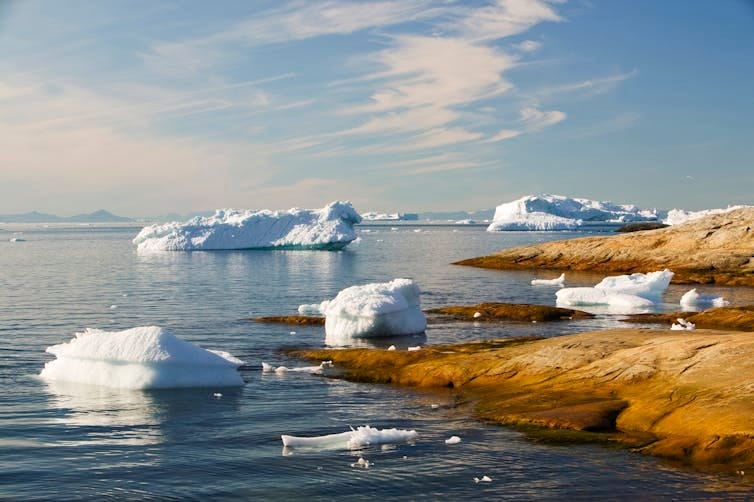
[Icebergs from the Jacobshavn Glacier in Greenland, the largest outside Antarctica, a glacier which is quickly melting away. Image by Ashley Cooper/Getty, via The Conversation]
Biomedical. Mike Stone’s piece “The Trump Card” was discussed in the 10/3/25 edition of LT. As i promised then, i’m letting you all know that Stone has now posted it on his ViroLIEgy page, which is fully accessible to the public. I’m including one of the segments from it which i posted in last week’s edition.
The Trump Card. Played to protect Big Pharma, not to expose it.. Mike Stone, 10/10/25.
On the surface, Trump’s press conference looked like a strike against Big Pharma. In reality, it was a masterclass in misdirection: vaccines were protected, Tylenol was sacrificed, and Big Pharma walked away stronger.
The takeaway is unmistakable: this was never about challenging the vaccine program. The spotlight was shifted onto Tylenol as the “cause” of autism, while vaccines were only criticized for their scheduling or additives—issues framed as already being “fixed.” In the end, the injections remain firmly in place, and a new pharmaceutical “treatment” for autism was introduced. Rather than a blow against Big Pharma, it’s a deflection that protects vaccines, redirects blame onto an over-the-counter drug, and conveniently expands the pharmaceutical market with new “solutions.”
This is the brilliance of the strategy: vaccines are never the root of the problem. They are recast as safe and essential, with only minor tweaks needed. Meanwhile, Tylenol becomes the scapegoat, and mothers who suspect vaccines are pacified by being told their voices are finally being heard while the system they distrust continues without interruption.
I realize there will be those who will be upset that I’m criticizing Trump and Kennedy Jr. for their approach. Some will argue that they are playing a long game, secretly dismantling the system from within. But I refuse to indulge in reading tea leaves or decrypting supposed coded messages. All I can do is take their words and actions at face value. And what they show is unwavering support for the vaccine paradigm, merely dressed up with a Tylenol scapegoat and a new drug rollout. Everything I’ve seen so far shows Trump and Kennedy Jr. to be pro-vaccine stalwarts aiming to make an inherently dangerous practice “safer.” Their words and actions bolster the pharmaceutical narrative and advance its agenda. Until I see otherwise, I will continue to call them out for doing so.
If Trump and Kennedy Jr. truly intended to dismantle the vaccine agenda—short of exposing the fraud of germ “theory” and virology—their first step would be obvious: repeal the 1986 National Childhood Vaccine Injury Act, the law that shields vaccine manufacturers from liability and effectively created a government-protected vaccine industry. Without removing that foundation, talk of “safer schedules” or “separating shots” is nothing more than window dressing.
What’s more, both Trump and Kennedy invoked the precautionary principle regarding Tylenol, warning against its use in pregnancy on the basis of possible risk. Yet this very principle is nowhere to be found when it comes to vaccines. The numerous side effects of vaccination—up to and including death—are already well documented, yet vaccines remain on the market and are even administered in combination within a short time frame before and after birth, despite the absence of comprehensive safety testing. The childhood vaccine schedule, packed with dozens of injections before the age of two, has never been properly tested as a whole for safety. If Trump and Kennedy Jr. were consistent, they would apply the same precautionary logic to vaccines that they now apply to Tylenol. Instead, vaccines remain untouched, preserved as a sacred pharmaceutical product, while blame is shifted elsewhere.
Still, some will insist that Trump and Kennedy Jr. are “white hats” secretly protecting the public from Big Pharma. They might even point to Kennedy Jr.’s 7-minute statement, released one week after the press conference, which at first glance seemed to dismantle a pro-vaccine narrative by challenging the idea that vaccines were responsible for the decline in disease mortality over the last century. But in the final moments, Kennedy revealed his hand. He insisted that vaccines are a “critical part of public health,” that they “can prevent infections” and the “serious injuries that accompany measles,” and that they “can prevent you from spreading measles to others.” He went further, promising that under President Trump’s leadership they would “ensure that America has the best childhood vaccine schedule” and “modernize American vaccines with transparent gold-standard science.” In other words, far from challenging the vaccine paradigm, Kennedy was reaffirming it with a full-throated endorsement. The message was clear: the program won’t be dismantled. It will be rebranded, polished, and preserved as a cornerstone of Pharma’s agenda.
The next day, Trump announced TrumpRx, a site designed to let consumers search for their medicines and then be redirected to manufacturers’ direct-to-consumer channels for supposedly cheaper pricing. He also struck a deal with pharmaceutical giant Pfizer, which is investing an additional $70 billion on research and manufacturing projects—particularly in cancer, obesity, immunology, and vaccines—over the coming years. In return, the company will receive a three-year grace period on the tariffs the administration plans to impose. Following the announcement, Pfizer shares rose more than 6%. According to Chris Meekins, managing director of health policy research at Raymond James, this was a clear win for Big Pharma: “If this is all that President Trump does on drug pricing, it is likely a win for the pharmaceutical industry.” He concluded that Trump’s announcement, on balance, would not be a serious blow to drugmakers.
Maybe time will prove me wrong. I hope it does, and that Team Trump truly turns out to be dismantling the pharmaceutical machine. If that happens, I will gladly and publicly apologize for my skepticism and give them the praise that they deserve. But I’m not holding my breath. Their words and actions point in the opposite direction. My intuition tells me the Trump card has been played—and it isn’t Pharma that’s being outmaneuvered. It’s the public.
4IR. Jeff Snider discusses a MAJOR signal of global deflation, a huge decline in sales across the entire German auto Industry (as wel as with Italy’s Ferrari luxury carmaker, and a huge jump in industrial production as a whole in Germany. A big reason is slowdowns in markets this industry exports to.
German Auto Just Crashed 20% in ONE Month. Jeff Snider/Eurodollar University, 10/9/25, 21 minutes.
“Germany’s auto production absolutely crashed, falling by almost 20% in just a single month. This becomes the latest stark warning about the direction of the global economy coming from the car business. And that report on production was corroborated by Mercedes, BMW, Porsche, Ferrari, all of them reporting results and forecasts this week that have sent their stocks plunging.”
And, while Trump is set to fly to Israel on Sunday to address the Knesset, Israels parliament, very interesting details are emerging about the “International Stability Force” which will be tasked with enforcing the agreement once ths proposed international authority body headed by Trump and Tony Blair.
U.S. to send some 200 troops to Israel to monitor ceasefire agreement. According to the officials, the U.S. troops are not intended to go into Gaza, but rather they are being deployed to help create a joint control center. i24NEWS, Mike Wagenheim, 10/10/25.
Israeli Prime Minister Benjamin Netanyahu approved the framework for the Gaza ceasefire and hostage release at a government meeting with President Trump’s Special Envoy to the Middle East Steve Witkoff and the President’s son-in-law, Jared Kushner Thursday night. According to the agreement, the United States will help support and monitor the agreement’s implementation, sending about 200 U.S. troops to Israel this week as part of a joint task force led by CENTCOM that includes partner nations, non-governmental organizations, and private-sector entities, with the ISF to “replace the IDF on the yellow line,” two senior U.S. officials have said.
According to the officials, the U.S. troops are not intended to go into Gaza, but rather they are being deployed to help create a joint control center to “coordinate various issues in the near future in Gaza until there is a permanent government in Gaza.” T [Right! :-) }he center is supposed to assist in the issue of bringing in humanitarian aid and logistical assistance and will also coordinate the various bodies and countries that will now arrive in the Gaza Strip. “The goal: so that there is no chaos, so that everyone can talk to everyone.”...There will be a lot of players now in the Gaza Strip, and they will have to coordinate between them - and that is exactly what the center will do - each of the countries and entities that will now be involved in Gaza will have representatives in the center,” one of the sources said.
According to the officials, Trump’s vision for what comes next is that a local police force be established in Gaza, that all terror infrastructure be destroyed, and that Gaza be a functioning economy. “You can’t have a functioning place where people live if you have terrorists and militias running the place and you don’t have good rule of law and good governance. So the goal is really to give the people who are there the opportunity to live a better life, but you need to have the right governance in order to do that, and that’s what everyone will endeavor to do.”
The official emphasized, “There will be no American soldiers on the ground, but there will be people who will report to us; aircraft may be operated over the Strip to monitor, but American soldiers will not be inside Gaza.” The deal was separated into two phases: a hostage release and a permanent ceasefire, with specific details on the redeployment of the Israeli army and the disarmament of Hamas.
“The Arab countries made a lot of commitments that they would like to see that happen. They’re going to commit a lot of resources, and they’ve committed to seeing Hamas demilitarized, and then we have a little bit of a trust-and-verify withdrawal mechanism set up with the Israelis that the more that those aims are achieved, we will hopefully be able to to get them to a full withdrawal, because there’s a lot of stability in Gaza,” one official said.
One of the senior officials said the deal started with a 20-point list for peace in the Middle East, combining principles from previous negotiations. The list was presented to the various Muslim and Arab leaders during the UN General Assembly, including Turkey, Egypt, and Qatar, where it received positive feedback, leading to further refinements. It included an apology from the Israeli Prime Minister to the Prime Minister of Qatar and the convening of a meeting in Sharm El Sheik with key mediators.
“I think the motivation from Israel to make the deal was the opportunity to convert their military victories over the last years with Hezbollah and with Hamas in Iran into political victories and to get back to their economy and to try to make more deals and get more Abraham Accords countries, and I think from Hamas and the Arab countries, there was a general fatigue with the way this war was going and a desire also to try something new,” the officials said about the motivation for this deal to have reached this far, unlike so many other failed attempts.
“Most people in Israel either have children or neighbors or friends who are fighting in the war, and I think there’s a real relief to see this done. But with that being said, there’s real fear there about what will happen next. You know, will Gaza come up again to pose a threat? And I think that that’s something that if the mechanism that we create and everyone behaves and works properly, then hopefully we can create a new paradigm that can lead to a more peaceful and prosperous place in the future.”
And, in the growing crisis environment which marks the global economy, the China state/business entity is moving to control its exports of rare earths, a sector which is critical for the 4IR, and regarding which China greatly dominates the locations of available resources.
Trump threatens ‘massive’ China tariffs as Beijing restricts rare-earth exports. Wall Street falls as US president raises prospect of another trade war and suggests meeting with Xi may not happen. Callum Jones in New York, 10/10/25.
Donald Trump has threatened again to impose “massive” US tariffs on China, accusing Beijing of “very hostile” moves to restrict exports of rare earths needed for American industry.Wall Street fell sharply after the US president reignited public tensions with the Chinese government, and raised the prospect of another acrimonious trade war between the world’s two largest economies.
Over the summer, relations had improved between Washington and Beijing, and Trump agreed to drastically reduce steep tariffs he imposed on China earlier this year, following negotiations between the two countries. “I never thought it would come to this but perhaps, as with all things, the time has come,” Trump wrote on his Truth Social website, claiming: “Ultimately, though potentially painful, it will be a very good thing, in the end, for the U.S.A. “One of the Policies that we are calculating at this moment is a massive increase of Tariffs on Chinese products coming into the United States of America. There are many other countermeasures that are, likewise, under serious consideration.”
A planned meeting between Trump and Xi Jinping in South Korea later this month may no longer happen, Trump suggested, saying “there seems to be no reason” to meet with the Chinese president. The US president’s threat sets the stage for another escalation in his volatile dispute with China. Just four months ago he described US relations with the country as “excellent” after signing off on a tariff reduction deal.
Trump repeatedly hiked US tariffs on Chinese goods in the spring, amid spiraling tensions between the two countries, to a peak of 145%. Beijing hit back, raising its own tariffs on US exports to 125%. But talks between officials, amid widespread concern over the impact of such exorbitant duties on the world economy, led to a fragile detente. US tariffs on Chinese products fell to 30%, while Chinese tariffs on US goods dropped to 10%. The president’s latest online attack on Beijing alarmed investors on Friday. The benchmark S&P 500 fell 1.5% and the Dow Jones industrial average retreated 0.8% in New York, while other leading markets also came under pressure. The FTSE 100 dropped 0.9% in London.
China is the world’s largest producer of rare earths, producing more than 90% of the world’s processed rare earths and rare-earth magnets. The 17 elements are critical for manufacturers of everything from electric cars to plane engines. Earlier this week, Beijing significantly expanded its export controls over rare earths, adding five new materials to its control list. Its last expansion of controls, back in April, prompted supply shortages around the world before a series of diplomatic deals helped resolve some of the issues.
“I have always felt that they’ve been lying in wait, and now, as usual, I have been proven right!” Trump claimed on Friday. “There is no way that China should be allowed to hold the World ‘captive,’ but that seems to have been their plan for quite some time, starting with the ‘Magnets’ and, other Elements that they have quietly amassed into somewhat of a Monopoly position, a rather sinister and hostile move, to say the least. “But the U.S. has Monopoly positions also, much stronger and more far reaching than China’s.”
Trump’s aggressive tariff strategy is a key pillar of his policy agenda. He has claimed higher taxes on imports from across the world will strengthen the US economy and raise trillions of dollars for the federal government. But tariffs are also often passed on to consumers, lead to higher prices. After years of heightened inflation, Trump has repeatedly claimed there now is none in the US. In reality, price growth has been rising.[EXAGGERATED. See a bunch of recent videos by Jeff Snider., the problem is NOT price growth, but deflation]
Ending this segment and this edition, a drastic step up in the pace of destabilization of the global ecosystem. I have huge problems wikth Guy McPherson, particularly ihis totally uncritical acceptance of the “Pandemic”/”COVID-19”/”SARS-CoV-2” disinformation narrative. But he hits the mark here, quoting the work of others.

The Rate of Environmental Change. Guy McPherson, 10/9/25.
If you have been following my work for more than 15 minutes, you undoubtedly know that Earth is amid abrupt, irreversible climate change. As a result of anthropogenic climate change, Earth is experiencing the most rapid change in planetary history. This change is irreversible. This abrupt, irreversible change was published in two reports produced more than six years ago by the Intergovernmental Panel on Climate Change, an organization designed-to-fail when it was created during the Ronald Reagan administration. Michael Oppenheimer, a Professor at Princeton University, concluded that the IPCC was designed to fail.
As I have also mentioned in this space, the situation is getting worse. Ongoing, accelerating anthropogenic climate change is likely to cause the extinction of all life on Earth, as reported in the peer-reviewed literature. As a result, today’s information is worse than the information I have presented before.
An article published at The Conversation is titled Earth is trapping much more heat than climate models forecast – and the rate has doubled in 20 years. The article was written by a Professor of Atmospheric Sciences in Australia, an Associate Research Scientist in Climate Science in France, and a Professor of Climate Science in Sweden. Here’s the lede, followed by two additional sentences to complete the first paragraph: “How do you measure climate change? One way is by recording temperatures in different places over a long period of time. While this works well, natural variation can make it harder to see longer-term trends.”
The following paragraph provides another answer to the question about measuring climate change: “But another approach can give us a very clear sense of what’s going on: track how much heat enters Earth’s atmosphere and how much heat leaves. This is Earth’s energy budget, and it’s now well and truly out of balance.”
You knew that, of course. I have reported the energy imbalance on this planet many times during the last couple of years.
In typically scholarly manner, the article at The Conversation cites other research and adds to it in the following three paragraphs: “Our recent research found this imbalance has more than doubled over the last 20 years. Other researchers have come to the same conclusions. This imbalance is now substantially more than climate models have suggested. In the mid-2000s, the energy imbalance was about 0.6 watts per square metre (W/m2) on average. In recent years, the average was about 1.3 W/m2. This means the rate at which energy is accumulating near the planet’s surface has doubled. These findings suggest climate change might well accelerate in the coming years. Worse still, this worrying imbalance is emerging even as funding uncertainty in the United States threatens our ability to track the flows of heat.”
What’s this about “funding uncertainty in the United States threaten[ing] our ability to track the flows of heat”? When the President in the country of my birth denies anthropogenic climate change and refers to it as a hoax, there are consequences. As reported by these scholars in The Conversation, the consequences include funding uncertainty leading to the “inability to track the flows of heat.” We are now witnessing the results of defunding NOAA and the National Weather Service in Kerr County, Texas and southern New Mexico. Deaths in these locales could have been prevented.
[This was in a comment on a weather blog i hag out at, Weather West, some info as two what’s going on with the NWS.
“The people running the models have been fired.
The data underlying the models is no longer being collected.
Folks who would have been updating the models have been fired.” ]
Beneath a subsection titled Energy in, energy out, seven paragraphs explain Earth’s energy imbalance: “Earth’s energy budget functions a bit like your bank account, where money comes in and money goes out. If you reduce your spending, you’ll build up cash in your account. Here, energy is the currency. Life on Earth depends on a balance between heat coming in from the Sun and heat leaving. This balance is tipping to one side.
Solar energy hits Earth and warms it. The atmosphere’s heat-trapping greenhouse gases keep some of this energy. But the burning of coal, oil and gas has now added more than two trillion tonnes of carbon dioxide and other greenhouse gases to the atmosphere. These trap more and more heat, preventing it from leaving. Some of this extra heat is warming the land or melting sea ice, glaciers and ice sheets. But this is a tiny fraction. Fully 90% has gone into the oceans due to their huge heat capacity.
Earth naturally sheds heat in several ways. One way is by reflecting incoming heat off of clouds, snow and ice and back out to space. Infrared radiation is also emitted back to space. From the beginning of human civilisation up until just a century ago, the average surface temperature was about 14°C. The accumulating energy imbalance has now pushed average temperatures 1.3-1.5°C higher.”
Well, no. The accumulating energy imbalance has now pushed average temperatures more than 2°C hotter, as agreed by governments of the world in October 2023. Either climate scientists cannot keep up with the ongoing exponential increase in Earth’s energy imbalance or they choose not to keep up. Beneath a section titled “Tracking faster than the models”, we find six short paragraphs of explanation: “Scientists keep track of the energy budget in two ways.
First, we can directly measure the heat coming from the Sun and going back out to space, using the sensitive radiometers on monitoring satellites. This dataset and its predecessors date back to the late 1980s. Second, we can accurately track the build-up of heat in the oceans and atmosphere by taking temperature readings. Thousands of robotic floats have monitored temperatures in the world’s oceans since the 1990s.
Both methods show the energy imbalance has grown rapidly. The doubling of the energy imbalance has come as a shock, because the sophisticated climate models we use largely didn’t predict such a large and rapid change. Typically, the models forecast less than half of the change we’re seeing in the real world.”
As I have pointed out previously in this space, the models are not keeping up with reality. Of more importance is the inability or unwillingness of climate scientists to keep up with climate science. When even the designed-to-fail IPCC concludes Earth is amid the most abrupt climate event in planetary history, and that change is irreversible, then it’s time for climate scientists to catch up to reality. Denial is not a viable strategy for anyone, including academic scientists.
The bottom line comes in the final two, one-sentence paragraphs at The Conversation: “Satellites, in particular, are our advance warning system, telling us about heat storage changes roughly a decade before other methods. But funding cuts and drastic priority shifts in the United States may threaten essential satellite climate monitoring.” Again, with the U.S. presidential administration stuck in denial, we are unlikely to witness good news on the climate front. Considering that every U.S. President in my life has been the worst U.S. President in my life, I doubt good news lies in the near future.